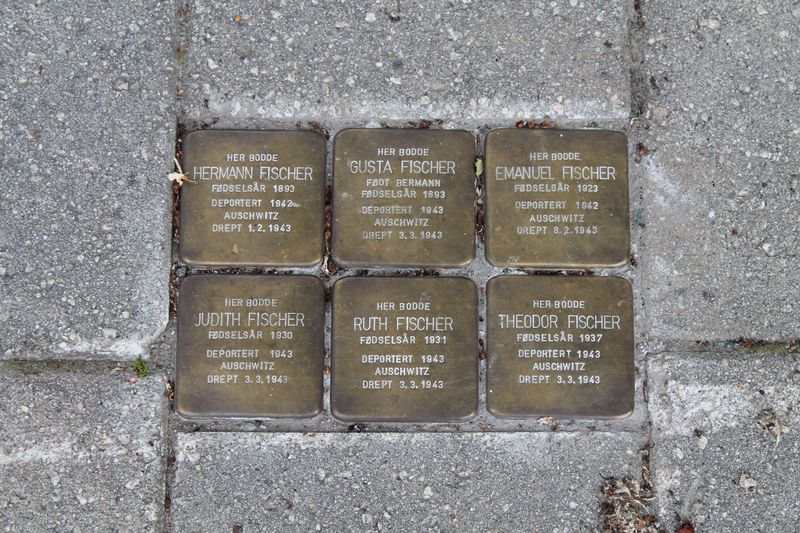
My mother often talked about the Fischer children. Always in a way as if she had something to do with their fate. She told the story with a guilty conscience. Every time with tears in her eyes.
The Fischer family had a clothes store in town and were active in social life. Hermann and Gusta had six children. Theodor was the youngest of the siblings. The two oldest sisters, Sara and Lilly, moved away from home when he was quite young. Back in town, Theodor, his brother Emanuel and their sisters Judith and Ruth lived with their parents.
The war came to town on 28 April 1940. The bombing lasted for four days.
My mother had absolutely no role in the fate of the Fischer family, so there was no reason for this to trouble her conscience. Except that she had believed the story that was told. The story was that all the Jews were to be sent out of the country and reunited with their European relatives. No one imagined in what way this reunion would take place. Surely for such a story of family reunification to work there must have been a story about us and them that was accepted as a truth. The Nazis and the propaganda apparatus were good at telling stories that started small and that were easy to accept both for the Jews themselves and the population that had tolerance for the Jews, but at the same time saw them as a little different.
The first thing that was introduced was that all Jews were to have a “J” stamped in their passports. But they got to keep their passports. This was in January 1942. Two months later, the Jewish paragraph was reintroduced into the constitution. Jews were thus no longer allowed to enter the country. In the same year, mandatory self-reporting was introduced for Jews, property and businesses were confiscated, and Jews were arrested and deported from the country. Most ended up in Auschwitz. Of 773 Jews, only 38 survived.
The father of the family Hermann was arrested in May 1942 and the eldest son Emanuel was arrested on 25th October. The day before, he and a friend had discussed whether they should escape to Sweden. On 30th November, the mother Gusta and daughters Judith aged 12, Ruth aged 11 and son Theodor aged 5 were arrested.
They were transported away from the town in a car ferry. Many of Ruth and Judith’s classmates turned up with some sweets so that they would have something to enjoy on the trip. Neighbours, friends, and townspeople had also turned up at the quay. Some of them told afterwards that Theodor had lost his teddy bear. There goes the Jews, people said.
The journey continued with MS Gotenland. The destination was Stettin, Germany – today Szczecin in Poland. The ship docked early in the morning of 27th February. The prisoners were stowed in fright cars and sent to Berlin, where they were forced to sign over their assets to the German state. The next day they were sent on to Auschwitz.
They arrived at Auschwitz on 3rd March 1943. Hermann and Emanuel had been killed in the same camp a week apart a month earlier. On arrival, only a few men fit for hard labor were selected from the lineup. All women, children, young and elderly people were sent straight to the gas chamber and murdered. Gusta, Judith, Ruth and little Theodor were among these.
It was probably the collective guilt that tore at my mother. That the whole town passively had accepted the stories they were told. When the brutality dawned on the townspeople, the reality was so incomprehensible that the emotions became difficult to sort.
The poet Arnulf Øverland said it this way:
You must not go to your business and pleasure,
Thinking of losses and gains and leisure.
You must not blame it on cattle and land,
Saying it’s all I can spare, understand?
You must not sit in your good cosy home,
Pitying poor people who are bound to roam.
You must not allow as some people do
the injustice that is not levelled at you!
With my last breath I cry till I fall:
You are not allowed to forget this at all.
Now there is war in Europe again. We must not sleep this time!
 Billy Bronco is telling you