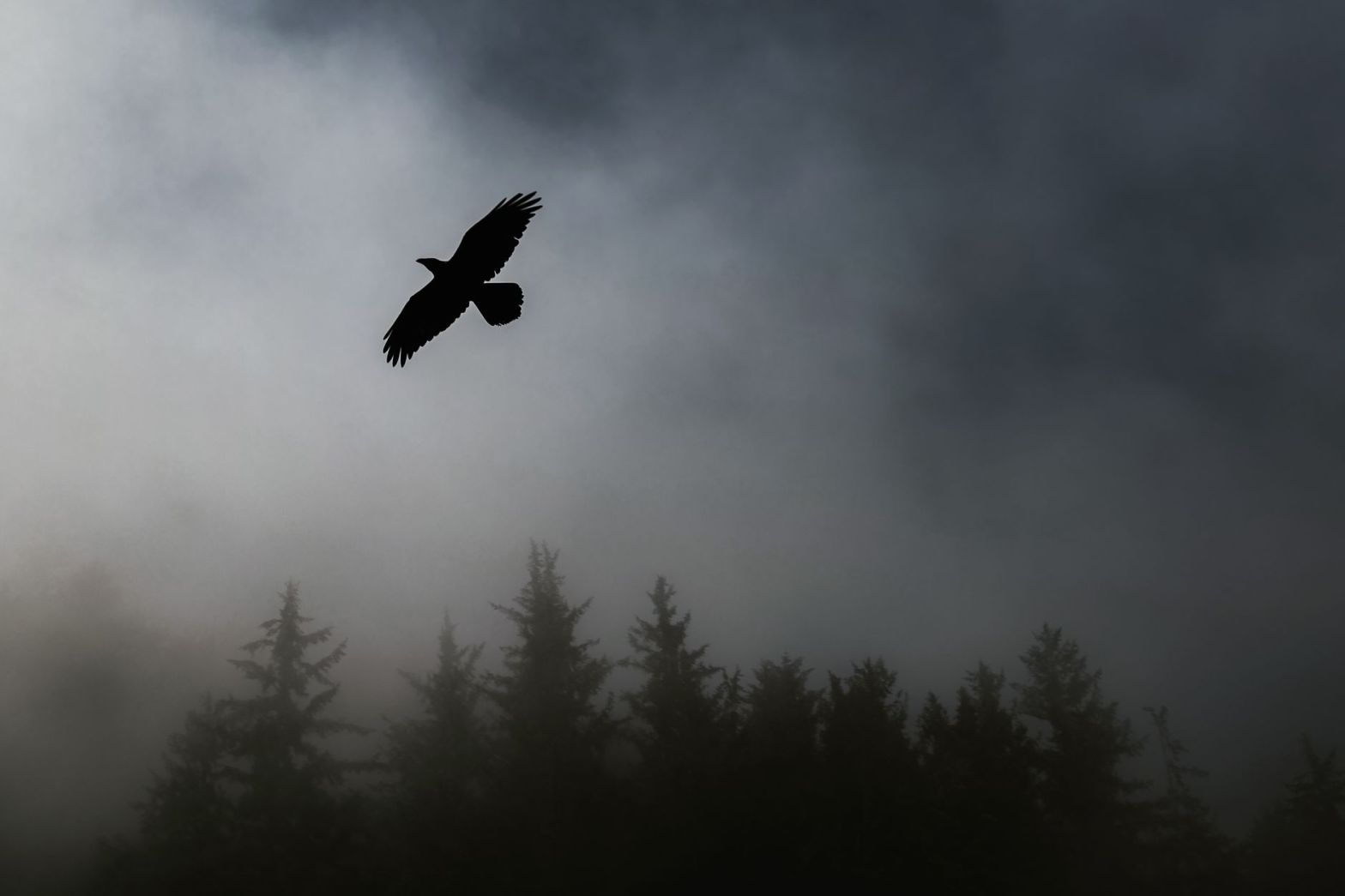
By most measures, I was an unusual child. I kept more company with animals than with people. There were cats, rabbits, budgies, pigeons – and a raven.
The cats and rabbits offered comfort enough. The Barbary dove, which I included in various amateur conjuring tricks, had its place. Even the budgie, a gift from an elderly aunt, brought its own peculiar charm. Yet it was the raven who became my closest companion.
The raven is a creature of myth. Not only cunning, smart, perceptive but also a bird of considerable size, capable of attaining old age. Several of the ravens at the Tower of London have lived to become forty years. In Norse mythology, the ravens Hugin and Munin flew out into the world each day to gather tidings of all that transpired in Asgard and Midgard. Each evening they returned, whispering what they had witnessed into the ear of the god Odin. Ravens have long been associated with mystery, and the names of Odin’s ravens, Hugin and Munin, signify thought and remembrance respectively.
Mine possessed not only a striking presence but also, as I chose to believe, a keen sense of humour. We suited one another. We gave each other something needed. It was, in its way, a mutually beneficial exchange. Every day I caught fish for him, while he was my wingman and squire.
Up in the hills, where the heather swayed in the wind like a restless sea and fern fronds curled in quiet patterns, the raven and I played together. He leapt from stone to stone, from tuft to tuft, watching me with bright, knowing eyes, as if he understood more than he ever chose to reveal. The wind carried our laughter – mine in voice, his in the beating of his wings and clipping sound. When we were together there was no distance between us, only the hills, the heather, and the strange companionship we shared. We invented tall tales. I told him stories, and I am certain he told me some in return.
When we wandered through the neighbourhood, he would perch on my shoulder, entirely free to leave at any moment. And sometimes he did. Now and then he would take flight to the great fright of the neighbouring women, landing uninvited upon balconies or slipping through open doors. Their cries would follow, for in their mild superstition the raven was a herald of misfortune, if not death itself. I often watched them chase him off with their brooms, and when he returned to me, I had the distinct impression that we shared a moment of private amusement at their expense.
It was never my intention to deprive him of his freedom. He stayed because he had once been abandoned. As he grew older, his excursions lengthened, until one day he found his own kind—and did not return. I missed him, of course, though I had always known it would end so.
I have often thought of our adventures. There was a freedom in that companionship, something rare and unguarded—a child and a bird sharing a world without boundaries. He was my dearest friend in those days and taught me more than I fully grasped as a child.
Many years after he left and found his purpose in life, I found myself walking through the local cemetery to lay flowers upon my father’s grave. Along the path, I passed a small group of people gathering around a fenced family plot. There, atop the tallest headstone, sat a large raven.
Some wished to chase it away, whilst others stood transfixed, marvelling at its size. I paused as well. The bird tilted its head and looked at me. It made a short, clipped sound. I answered in kind, pressing my tongue to the roof of my mouth to mimic the noise. The raven repeated it. I responded again, raising my hand in a gentle motion.
Suddenly, it leapt—gliding briefly towards me, feet extended. It landed on my arm as though it had done so a thousand times before and immediately set about inspecting me, pecking lightly at my cheek and teeth. We exchanged our strange, clicking language to the astonishment of those around us.
“Is it yours?” someone asked.
“One cannot own a raven,” I replied.
I stroked its head and down along its back. I knew then that this was my old companion. We were both grown now. Standing there, I felt certain that he too remembered that innocent time we shared.
As children, we had never questioned our bond. We shared no language, yet understood one another entirely. The world had been simpler then. When I tossed a stick, the raven took off at once into the air—not to retrieve it, but to follow its arc. It was a game without rules, where freedom itself was the only purpose. On certain evenings, as the shadows stretched long, we would sit together in silence—two beings shaped by different worlds, yet joined in imagination and presence.
Now he sat upon my arm once more, gazing at me with eyes that seemed to recall the paths we had walked. He, too, had lived a life—perhaps one filled with experiences and dreams beyond my imagination.
At last, the raven spread his wings and flew towards the edge of the forest, where the wind in the treetops blended with the rhythm of his wings.
I felt a small sorrow as he departed again, yet also a quiet joy that life had treated him well. More than anything, however, I felt a touch of envy—that he had never quite managed to teach me how to fly.
At least, not in a way others could see.

